Clients Paying Late? How to Chase With Proof
When it was due, what you agreed, the hours you put in and how they answer: four records that turn chasing a late payer into two lines and a fact.
It's the 15th. Marcus still owes you $640 for the deck you stained. You finished on the 1st, so it's two weeks late. Or is it? You're not sure you sent the invoice the same day. When you call him, he asks what the extra $120 was for, and you're scrolling back through three weeks of messages to find where he agreed to the second coat on the railing.
Chasing money is hard enough. Chasing it without the facts is worse, because every question the client asks sends you digging.
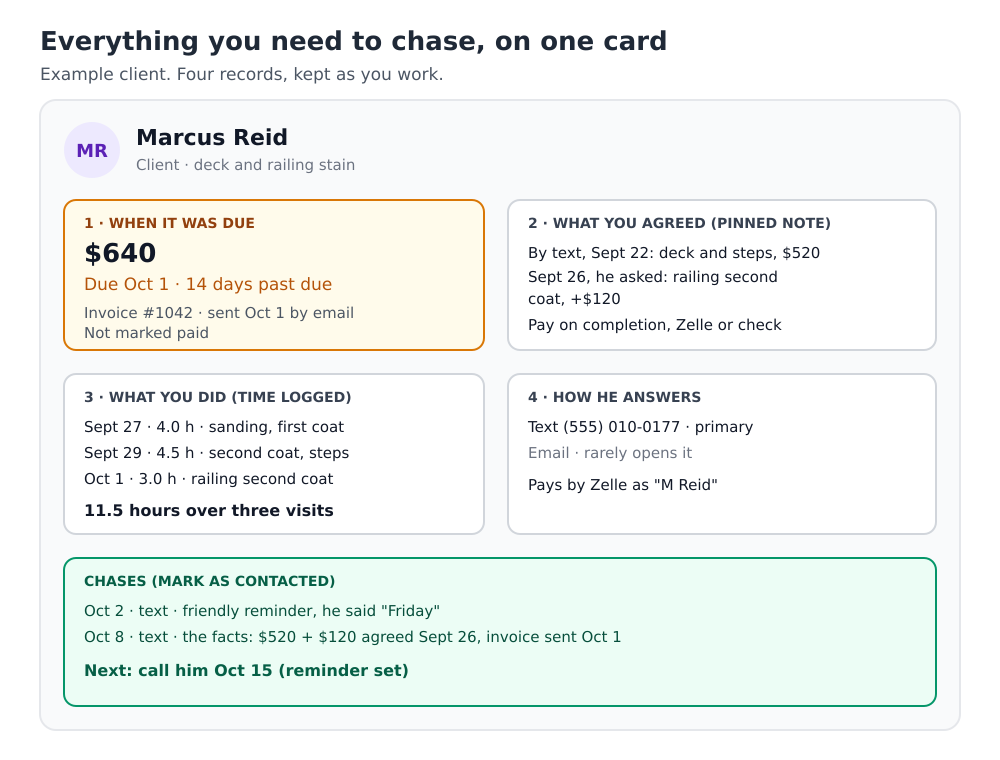
The fix: four records, kept as you work, so the chase is short. When it was due, what you agreed, what you actually did, and the way this client actually answers. With those, a reminder is two lines and a fact, not an argument.
This guide is for anyone who gets paid by clients: trades, designers, photographers, writers, cleaners, coaches.
Last checked: October 2026. The client and numbers below are made up. This is general information, not legal advice. Velvet Ledger isn't connected to any court, government body or debt-collection service; we've seen this come up for a lot of people, so here's how our tools can help.
Who owes me money right now?
Start with one list instead of a feeling. In Velvet Ledger, the dashboard's Settle up tab shows money coming in that's past due, most overdue first: "Marcus Reid, $640, 14 days past due." The words are deliberately calm, "past due" rather than "late", because you'll be talking to these people again.
To get money on that list, record it as owed when the work is done. In Quick Capture you can type it as you'd say it, "Marcus owes me $640 for the deck stain", or make an invoice.
On paper: one page, one line per unpaid job: client, amount, date due, date you last asked.
Why do clients really pay late?
Usually not because the money isn't there. Most late payments are a quiet disagreement about what the bill should be. In a survey of UK plumbers, the top reasons for payment disputes were that the customer couldn't afford the work (45%), didn't expect extra costs (20%), or thought some of the work wasn't needed (9%) (WRAS). Debt collectors add the everyday ones: the invoice never arrived, the details on it were wrong, or the person who approves payments is away (Atradius Collections).
Each reason has a record that answers it:
| What they say | What answers it |
|---|---|
| "I never got the invoice." | The invoice marked sent, with the date and where you sent it. Resend it the same day. |
| "I didn't realize it would cost that much." | The price you agreed, in your note, with the date and where you agreed it. |
| "That's more than we agreed." | An itemized invoice: the original price, then each extra on its own line, with the date they asked for it. |
| "I don't think that part was needed." | The note where they asked for it: "Sept 26, he asked: second coat on the railing." |
| "What were all these hours for?" | Time logged per visit, with what you did each time. |
| "I can't pay it all right now." | A payment plan agreed in writing, each part payment logged as it comes in. |
| "The person who pays is away." | Who handles their payments, saved on their card, so you know who else to ask. |
Notice that most of these are settled before the invoice ever goes out. When the cost grows, say so the moment it does: text the new price, wait for a yes, and note it on their card. Then the final bill is never a surprise.
When was the payment actually due?
Whatever date you and the client agreed. Write it down, or it's whatever each of you remembers.
- Put a due date on every invoice, with your payment terms ("due on receipt", "within 14 days"). In Velvet Ledger, an invoice's due date becomes the payment's due date, and that's what "14 days past due" counts from.
- Mark the invoice sent when you send it. Then "I never got it" has an answer: "Sent Oct 1, by email, to the address you gave me." An invoice that was never marked sent is also your sign to send it now.
- No invoice? Give the payment an expected date when you log it.
What did we agree, and where did we agree it?
Most payment arguments aren't really about money. They're about what was included. Keep what you agreed in a note on the client's card, pinned, with the date and where you agreed it:
Agreed by text, Sept 22: stain deck and steps, $520. Second coat on the railing, +$120 (he asked, Sept 26). Pay on completion, Zelle or check.
Add to it the moment anything changes. A short line on the day ("+$120, second coat, he asked by text") is worth more than an hour of scrolling later. It's also how you see what scope creep cost you, because every extra is written down.
What did I actually do?
When a client questions the hours, answer with dates and times, not memory.
- Time each visit or task. Start the timer when you start; the visit then shows how long it took. Over a job, you'll have the real total: 11.5 hours across three visits, not "about two days".
- Note what you did on the appointment itself: "Sanded and first coat, steps and deck."
- Bill from it, line by line. An invoice made in Velvet Ledger can list the time you spent and each extra on its own line, so the client can see how the total added up, and the hours on the invoice match the hours in your record. Our invoice guide walks through it.
Everything you logged also shows on the client's card, in order, so the whole job is in one place when you need it. Over time, the same hours show what each client is really worth: Contact Analytics & Insights works out revenue and profit per hour for every client.
How do I reach them so they actually answer?
Every client has a channel they ignore and one they answer. Some never open email but reply to a text in minutes. A business might route invoices to an accounts-payable inbox, not to the person you worked with.
- Save every way to reach them on their card, and mark the one they answer as primary.
- For businesses, save who handles payments too: add the accounts email or phone as a contact method labelled "Accounts", with the name of the person who approves payments.
- Log each chase. Use Mark as contacted, with the date and a note ("texted reminder, he said Friday"). Then you never have to wonder whether you already asked, or when.
When and how should I chase?
A simple rhythm, each step set as a follow-up reminder so it shows on your calendar and dashboard:
- Due date + 1 day: a friendly nudge. "Hi Marcus, a quick reminder that the $640 for the deck was due yesterday. Zelle or check both work. Thanks!"
- Due date + 7 days: the facts. "Following up on the $640 from Oct 1 (invoice sent that day). That's $520 for the deck and $120 for the railing's second coat you asked for on Sept 26. When can I expect it?"
- Due date + 14 days: call. People who ignore messages often pick up. Agree a date, then note it on their card.
- Due date + 30 days: a final, polite notice in writing. Say what you'll do next and by when. Check your options first (below).
Keep every message short, specific and kind. You want to get paid, and if possible you want them to book again.
What are my rights if a client won't pay?
It depends on where you are and who the client is. Two examples:
- New York City: work worth $800 or more (including $800 across 120 days) must be agreed in writing, and you must be paid by the agreed date, or within 30 days of finishing if no date was set. You can file a complaint with the city, and may be able to recover double the unpaid amount (NYC DCWP). Some workers aren't covered, including lawyers, licensed medical professionals and anyone hired by a government (NYC FAQ). New York State has its own Freelance Isn't Free Act, in force since August 28, 2024, with complaints going to the state Attorney General (NY DOL).
- United Kingdom, business clients: if another business pays late, you can claim statutory interest at 8% plus the Bank of England base rate, and a fixed sum of £40, £70 or £100 depending on the debt (GOV.UK, fixed sums). It covers sole traders and other businesses dealing with each other, not consumers buying for personal use. It doesn't apply if your contract sets its own late-payment rate, and if no date was agreed, a payment only counts as late 30 days after the invoice was received or the work was done, whichever is later (GOV.UK). These rules may change: a Commercial Payments Bill introduced in May 2026 is still going through Parliament (GOV.UK).
Neither would help with Marcus: his $640 job is under New York City's $800 threshold, and as a homeowner he'd be a consumer under the UK rule. Elsewhere, and for jobs like his, check your city or state's rules, or small claims court. A record of the due date, the agreement, the work and every reminder is what any of these routes asks you for.
How do I get paid on time next time?
- Take a deposit for anything that needs materials or blocks out your calendar.
- Agree the price and the due date before you start, in writing, and put the due date on the invoice.
- When the cost grows, ask before you do the work. Text the new price, wait for a yes, and note it on their card.
- Check how they paid last time, before you quote. In Velvet Ledger, open Contacts → Contact Analytics & Insights. Cash-flow risk by client shows how often each client paid on or before the due date, sets it against how profitable they are, and tells you how much of your income comes from clients who often pay late. Each client lands in one of four groups: Champions, Valuable, slow to pay, Steady payers, and Slow to pay, lower margin. It's only as good as your records, which is one more reason to put a due date on every invoice and mark each payment when it arrives.
A slow payer isn't necessarily a bad client. Marcus, profitable but slow, would land in "Valuable, slow to pay", and that's something to be aware of, not a reason to drop him. Use it to plan the next job:
- Ask what's behind it. Some clients pay on a fixed day each month, wait for their own customers to pay them, or need someone else to approve it. Knowing that, you can set a due date that fits.
- Split it into stages: a deposit up front, part at the halfway point, the rest on completion. Smaller amounts are easier to pay on time.
- Agree it in writing before you start, and note it on their card, so next time starts from what worked.
Does this sound like your month?
We're building Velvet Ledger around how people who work for themselves actually work. If you've found a way to get late payers to pay, or something here doesn't fit your work, tell us: support@velvetledger.io.
Keep going
- Need an invoice with a due date? Free invoice template
- Payments coming in on Venmo, Cash App and cash? Which payments are income?
- Want the right questions answered before the first job? Free client intake forms
Sources
Checked October 2026.
- Plumbers call for more support on managing customer services, WRAS
- Top 13 excuses for late payment, Atradius Collections
- Freelance worker rights, NYC Department of Consumer and Worker Protection
- Freelance Isn't Free Act: frequently asked questions, NYC DCWP
- Freelance Isn't Free Act, New York State Department of Labor
- Late commercial payments: charging interest and debt recovery, GOV.UK
- Interest on late commercial payments, GOV.UK
- Claim debt recovery costs on late payments, GOV.UK
- Commercial Payments Bill: overview, GOV.UK