Venmo, Cash App or Cash: Which Payments Are Income?
For lash techs, stylists and nail techs: tell client payments from friends paying you back and clients covering supplies, so every deposit is explained.
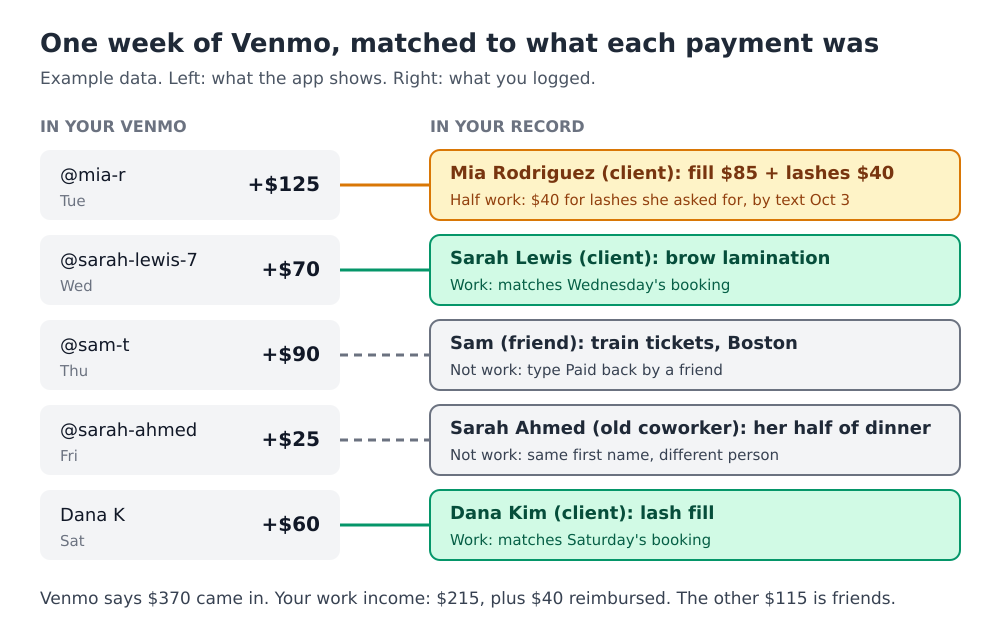
It's the last Sunday of the month. Your booking app says you made $2,140. But there's also the cash in the envelope, a Venmo from "mia-r", a Cash App payment from "$miarose", and $90 from your friend Sam for the train tickets you booked. Some of that is work, some isn't, and some is a client paying you back for the lashes she asked you to buy.
The fix is one habit: log every booking with how it was paid. Then every work payment in your apps has a match, and whatever is left over is short enough to explain in a line: "Sam, train tickets." Without that record, you're trying to prove that a deposit wasn't from work. With it, you're pointing at a list.
This guide is for lash techs, hairstylists, nail techs and other solo beauty pros who get paid in cash, Venmo, Cash App and Zelle.
Last checked: October 2026. The numbers are a made-up example; swap in your own. This is general information, not tax advice. Velvet Ledger isn't connected to the IRS, HMRC or any government scheme; we've seen this come up for a lot of people, so here's how our tools can help.
Why doesn't my booking app's total match what I earned?
Because it only counts the payments it processes. Cash, Venmo, Cash App and Zelle happen outside it. Reviewers of the big booking apps say the same: payments taken outside the app don't show in their earnings (GlossGenius reviews on Capterra).
What to do: log every payment yourself, right after the visit, with who, what for, how much and how it came in.
In Velvet Ledger: open Quick Capture and type it the way you'd say it, for example "Mia paid $85 Venmo for a fill, rebook in 3 weeks." It finds Mia, records the payment as Venmo and adds the rebook. You check it before it saves. In a notebook: date, client, service, amount, method, every time.
Is money a friend pays you back on Venmo income?
Usually not. The IRS says money from friends and family that's a gift, or pays you back for a personal expense like a split meal or a shared ride, isn't taxable income (IRS). But it lands in the same app as your clients' payments, so it's on you to show what it was. The IRS also suggests marking these payments as personal in the app when you can.
What to do: log it anyway, under its own type, with a note. Add a type such as Paid back by a friend once, then log Sam's $90 under it: "Train tickets, Boston." It's explained the day it happens, not six months later. In Velvet Ledger it still shows in your money-in totals, so filter by type when you want work alone.
Is a client paying you back for supplies income?
It arrives as part of her payment, so keep a record of what it covered and let your accountant decide how to treat it. Rules differ by country. The risk is forgetting: a month later, Mia's $125 looks like $125 of profit, when $40 of it paid for the lashes she asked you to buy.
It happens whenever a client wants something you don't stock and texts that she'll cover it: a lash curl or color, a nail shade for her wedding, clip-ins or a veil pin, or the drive out to her.
What to do, the day it happens:
- Log what you spent as an expense on that client: the $40 of lashes, linked to Mia. In Velvet Ledger, her card then shows what she really left you: $85, not $125.
- Log the drive. Add the miles to the appointment with a Mileage Tracker tag; Finances adds them up for the month.
- Note what her payment covered: "$85 fill + $40 lashes she asked for, agreed by text Oct 3." Pin the text agreement to her card.
- Tag the expense and the payment Client reimbursed, so you can filter by that tag and hand your accountant one list.
How do I keep track when one client pays under different names?
Give every client one card with every name they use. Mia is @mia.glows on Instagram, @mia-r on Venmo and $miarose on Cash App. Two people called Sarah, one a client and one an old coworker, get told apart by their handles.
In Velvet Ledger: open the client, add their Instagram under contact methods and their Venmo and Cash App names under payment platforms, and pin a note with anything agreed in their messages. If you only remember a Cash App name, teach Quick Capture once: Quick Capture → Parser Settings → Contacts, under Contact Nicknames, and add "miarose" for Mia. Then "miarose paid 90 cash app" lands on Mia. On paper: one row per client, one column per app.
Should I just get a Venmo or Cash App business profile?
It helps from here on: client payments go to one place and friends to another. Venmo, for example, offers a separate business profile (Venmo Help). Check each app's current fees and terms first. It doesn't fix the past, though, and it doesn't say what each payment was for. Clients will still send money to your personal account sometimes, and a client's payment can still include supplies. You'll want the record either way.
What's a quick weekly routine?
Ten minutes on a Sunday:
- Open Venmo and Cash App and scroll the week.
- Match each work payment to a booking you logged. A handle you don't recognise? Check your clients' cards.
- Log anything left over under its own type, with a note.
- Count the cash envelope against the cash payments you logged, then pay it into the bank and note which bookings the deposit covers: "Paid in $640 on Oct 18: cash from six bookings, Oct 1–17."
You'll catch the booking you forgot to log, the client who paid twice, and the personal payments, explained while you still remember.
What do I show a landlord or my accountant?
One month, split by what the money was and how it came in:
| This month | Amount |
|---|---|
| Work income: card, through the booking app | $2,140 |
| Work income: Venmo | $1,080 |
| Work income: cash | $640 |
| Work income: Cash App | $380 |
| Work income total | $4,240 |
| Clients paying you back for supplies | $40 |
| Friends paying you back | $115 |
The booking app showed about half of the work income.
For a landlord or lender: when you make an income packet in Velvet Ledger, you tick the income it covers, so the bookings go in and Sam's tickets stay out. It lists which statements go with it, one per payment method. If someone asks about a deposit you left out, its note says what it was. Your statements stay with you.
For your accountant: the work income by month, plus the Client reimbursed list. Work income counts as income, cash included, and payment apps send the IRS a Form 1099-K when your business payments pass a threshold (more than $20,000 across more than 200 payments, as of October 2026), and can send one below it (IRS). Check with a tax professional.
Tip: if you're applying for a mortgage
Payroll explains itself on a bank statement; Venmo and Cash App transfers don't. US lenders usually ask you to explain large deposits, and under Fannie Mae's rules a single deposit over half your monthly income has to be sourced if it goes toward a purchase (Fannie Mae Selling Guide). With every deposit logged, your letter of explanation is copied from your record, not rebuilt from memory:
$1,200 on Sept 14 from $janeweds via Cash App: bridal party lashes for five, booked Aug 2.
Cash deposits are the hardest to explain, because the statement shows only "cash deposit" and an amount. If you logged each cash payment the day you took it, and noted which bookings each bank deposit covers, you can show when and why you got every dollar: "$640 paid in on Oct 18: six cash bookings, Oct 1–17, listed with dates and clients." Paying cash in regularly, in batches that match your record, keeps that simple.
Your record supports the application; it doesn't replace what the lender asks for, which for self-employed income is usually your tax returns. Rules differ by lender and country.
Does this sound like your month?
We're building Velvet Ledger around how solo beauty pros actually work. If your clients pay under three names, your friends pay you back on the same apps, or you have a system that works better than this one, we'd love to hear it: support@velvetledger.io.
Keep going
- See it on one client's card: Velvet Ledger for mobile beauty pros.
- Rent a chair or a suite? Salon suite vs booth rent vs commission.
- Need to show your income soon? Make an income packet.
Sources
Checked October 2026.
- Understanding your Form 1099-K, IRS
- Business profile payment methods, Venmo Help
- B3-4.2-02: Depository Accounts (large deposits), Fannie Mae Selling Guide
- GlossGenius reviews, Capterra