Self Assessment for Side Hustles: Your 31 January Checklist
Side income over £1,000 in 2025 to 2026? Register, choose the trading allowance or expenses, and file by 31 January 2027. Dates and rules from GOV.UK.
You have a job, and something on the side: nails at the weekend, wedding cakes, dog walking, a bit of photography. Between April 2025 and April 2026 it brought in £3,400. Now it's autumn, HMRC's adverts have started, and you're wondering whether any of this applies to you.
The short answer: if everything you earned on the side, added together and before expenses, came to more than £1,000 between 6 April 2025 and 5 April 2026, you need to register for Self Assessment and file a tax return online by 31 January 2027. Under £1,000, you usually don't need to do anything (HMRC).
This guide is for people in the UK with a side income alongside a job. It's general information, not tax advice: HMRC's own tools and an accountant are the places to check your situation.
Checked against GOV.UK in October 2026, for the 2025 to 2026 tax year. Velvet Ledger isn't connected to HMRC or any government scheme. We've seen this deadline catch people out, so here's what to do and how our tools can help.
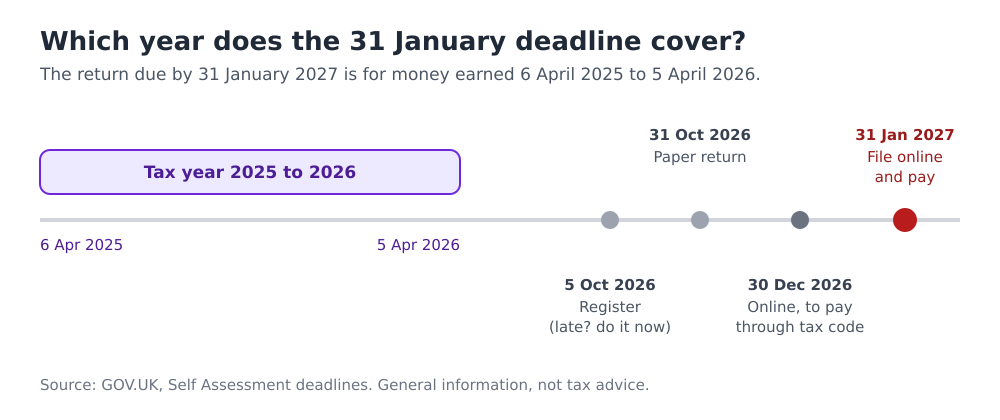
What are the deadlines for the 2025 to 2026 tax year?
| Date | What's due |
|---|---|
| 5 October 2026 | Tell HMRC you need to file (register), if it's your first time |
| 31 October 2026 | Paper tax returns |
| 30 December 2026 | Online returns, if you want the tax collected through your tax code |
| 31 January 2027 | Online tax returns, and paying what you owe |
| 31 July 2027 | Second payment on account, if you make them |
Source: GOV.UK, Self Assessment deadlines.
Do I need to file a tax return for my side hustle?
Usually, if your side income was over £1,000 in the tax year. That £1,000 is the trading allowance, and it covers all your side income added together, before expenses: £600 from photography plus £500 from social media posts is £1,100, so you'd need to register (HMRC).
Selling your own unwanted things, like old clothes or books, usually isn't trading. Providing a service for payment, or regularly buying and selling for profit, usually is. HMRC has a free checker: check if you need to send a tax return.
I missed the 5 October deadline to register. What now?
Register now. If you register after 5 October, HMRC sends you a letter or email with a new deadline: three months from the date on it (GOV.UK). Registering gives you the Unique Taxpayer Reference (UTR) you need to file, so don't leave it until January.
Should I claim the trading allowance or my expenses?
One or the other, not both. You can take £1,000 off your side income as the trading allowance, or take off your actual business expenses instead (GOV.UK). One catch: you can't use the allowance for side work done for your own employer (or your spouse's or civil partner's), for a company you or someone connected to you controls, or through a partnership.
Pick whichever is bigger:
| Income | Take off | Taxable profit | |
|---|---|---|---|
| Expenses were £620: claim the allowance | £3,400 | £1,000 allowance | £2,400 |
| Expenses were £1,450: claim expenses | £3,400 | £1,450 expenses | £1,950 |
You can only make that choice if you know your expenses: products, supplies, equipment, mileage, a share of your phone. That's why it pays to log them as you go, not in January.
How much tax will I pay on my side hustle?
It depends on your total income, but for most people with a job, the job already uses up the £12,570 Personal Allowance, so side profit is taxed at your main rate: 20% for basic-rate taxpayers in England, Wales and Northern Ireland (GOV.UK). Scotland's rates differ.
In the example above, £2,400 of profit at 20% is £480 of Income Tax. That assumes a basic-rate taxpayer in England, Wales or Northern Ireland; a higher-rate taxpayer would pay 40% (£960), and Scottish rates and bands are different.
National Insurance on self-employed profits (Class 4) starts at £12,570 of profit, at 6% up to £50,270 for 2025 to 2026, so a small side hustle often pays none (GOV.UK). You no longer have to pay Class 2: with profits of £6,845 or more for 2025 to 2026 you get the State Pension credit automatically, and below that you can choose to pay £3.50 a week to protect your record (GOV.UK, HMRC manual).
Estimate your own bill with HMRC's Self Assessment tax calculator.
Can I pay through my tax code instead?
Yes, if all three apply: you already pay tax through PAYE (a job or a pension), you owe less than £3,000, and you file online by 30 December 2026 (or on paper by 31 October) (GOV.UK). The tax is then collected through your pay over the next tax year, instead of one bill in January.
What are payments on account?
Advance payments towards next year's bill, made on 31 January and 31 July. You don't have to make them if last year's bill was under £1,000, or if more than 80% of your tax was already paid another way, such as through your job (GOV.UK). With a £480 bill, as in the example, they wouldn't apply. But if your bill is £1,000 or more and less than 80% of your tax was paid through your job, you'll owe the bill plus a first payment on account (half the bill again) on 31 January. HMRC's own example: a £3,000 bill means £4,500 due.
What records do I need, and how long do I keep them?
Your income and expenses for each tax year (6 April to 5 April), with receipts and statements behind them. Most sole traders now use the cash basis by default: income counts when you receive it, and expenses when you pay them (GOV.UK).
Keep them for at least five years after the 31 January deadline: records for 2025 to 2026 until at least the end of January 2032 (GOV.UK).
How do I get my numbers out of Velvet Ledger?
If you've logged your side income and expenses as they happened:
- Set your currency to pounds in Settings, if you haven't.
- Open Finances and choose Month. Step back to April 2025, and note Received and Total Expenses for each month through to April 2026.
- Mind the edges. The tax year starts on 6 April, so 1 to 5 April 2025 belongs to the year before, and 1 to 5 April 2026 to this one. Finances doesn't have a tax-year view yet, so check those few days by hand.
- Compare your expenses with £1,000, and claim whichever is bigger.
Velvet Ledger isn't HMRC-recognised software for filing or for Making Tax Digital. It's where your records live; you file with HMRC's own service, or through an accountant.
Will Making Tax Digital affect me?
Probably not yet. Making Tax Digital for Income Tax means keeping digital records and sending HMRC quarterly updates through compatible software. It applies from 6 April 2026 to sole traders and landlords with qualifying income over £50,000, from April 2027 over £30,000, and from April 2028 over £20,000. Qualifying income means gross self-employment and property income, before expenses (HMRC).
Everyone, signed up or not, still files the 2025 to 2026 return the usual way by 31 January 2027 (HMRC).
Will apps and platforms tell HMRC about my income?
Some will. Since 1 January 2024, digital platforms that you sell goods or services through may need to collect your details and report them to HMRC. Being reported doesn't automatically mean you owe tax (GOV.UK). Either way, registering when your side income is over £1,000 is your job, not the platform's (GOV.UK).
What if I'm late?
Filing late costs £100 straight away, then £10 a day after three months (up to £900), with more at six and twelve months. Paying late adds 5% of the unpaid tax at 30 days, six months and twelve months, plus interest. If you have a reasonable excuse, you can appeal (GOV.UK).
Does this sound like your autumn?
We're building Velvet Ledger around how people who work for themselves actually work, on both sides of the Atlantic. If your side hustle keeps its records some other way, or you'd like a tax-year view in Finances, tell us: support@velvetledger.io.
Keep going
- Paid in cash and by bank transfer, and some of it is friends paying you back? Which payments are income? (written for US payment apps; the habit is the same)
- Need to show your income for a flat or a mortgage? Make an income packet
- Free client forms for your side hustle: client intake form templates
Sources
Checked October 2026.
- Self Assessment tax returns: deadlines, GOV.UK
- Say "I do" to getting your side hustle tax right, HMRC
- Check if you need to send a Self Assessment tax return, GOV.UK
- Tax-free allowances on property and trading income, GOV.UK
- Income Tax rates and Personal Allowances, GOV.UK
- Rates and allowances: National Insurance contributions, GOV.UK
- National Insurance Manual NIM70001: Class 2 contributions, HMRC
- Estimate your Self Assessment tax bill, GOV.UK
- Pay your Self Assessment tax bill: through your tax code, GOV.UK
- Understand your Self Assessment tax bill: payments on account, GOV.UK
- Business records if you're self-employed, GOV.UK
- How long to keep your records, GOV.UK
- Sole traders and landlords earning more than £30,000 urged to act now (Making Tax Digital), HMRC
- Self Assessment deadline incoming: 100 days to go, HMRC
- Selling goods or services on a digital platform, GOV.UK
- Self Assessment tax returns: penalties, GOV.UK